
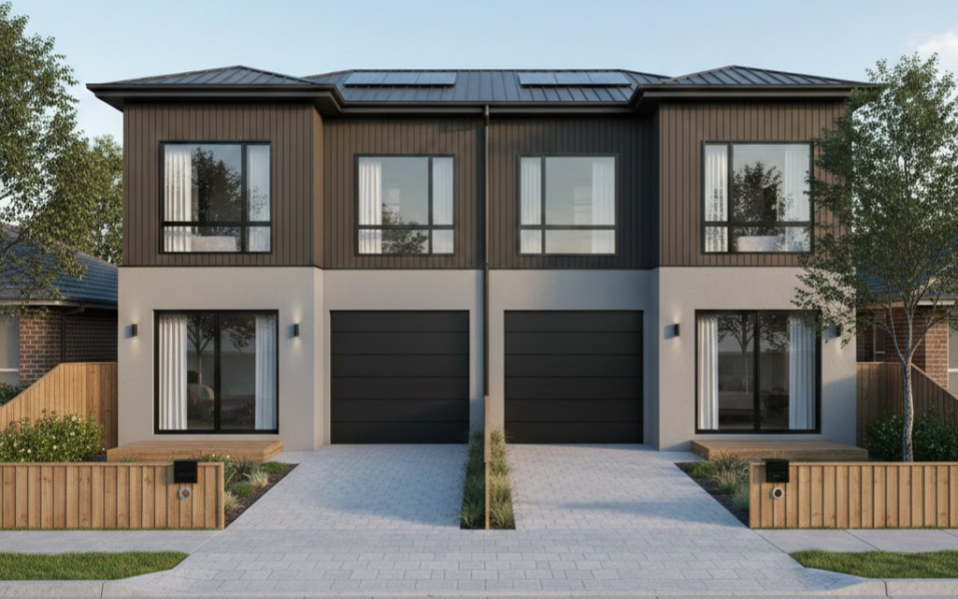
VC288 + VicSmart: faster planning permits for two homes on a lot — and what it means if you’re building with Panelhome

Ian Hammond
Victoria’s planning system has had a major (and very practical) update for people who want to build two dwellings on one block or pursue a two‑lot subdivision.
From 16 October 2025, Amendment VC288 took effect across the Victoria Planning Provisions (VPP) and all planning schemes, adding new classes of applications that can be assessed through VicSmart — the state’s fast‑tracked planning permit pathway. (Victoria Government Gazette)
If you’re looking to build with Panelhome, this change matters because it can shorten the planning stage dramatically (where you’re eligible), and that pairs well with a system that’s designed to move quickly once approvals are in place.
Below is a plain‑English breakdown of what changed, what didn’t, and how to take advantage of it.
First: what VicSmart actually is (and why it’s different)
VicSmart is a “simple and fast” planning permit process intended for straightforward applications. The key features are:
- a 10 business day assessment process
- no advertising / no neighbour notification
- pre‑set information requirements and matters council can consider
- decision by the CEO/delegate, rather than the usual council process. (Planning)
That last point is important: because VicSmart is designed to be objective and checklist‑driven, you don’t get the same “negotiation” that can happen in the standard planning process. You either meet the eligibility criteria, or you don’t.
What VC288 changed in one sentence
VC288 expands VicSmart so eligible proposals for two dwellings on a lot and more types of two‑lot subdivisions can be assessed via the 10‑day VicSmart pathway. (Victoria Government Gazette)
Change 1: two dwellings on a lot can now qualify for VicSmart (in the right zones)
From 16 October 2025, VicSmart can apply to proposals to:
- construct one dwelling where there is already (no more than) one existing dwelling on the lot
- extend a dwelling where there are two dwellings on the lot
- construct two dwellings on the lot. (Planning)
Where this applies
The VC288 VicSmart pathway for “two dwellings on a lot” applies in these zones:
- Mixed Use Zone
- Township Zone
- Residential Growth Zone
- General Residential Zone
- Neighbourhood Residential Zone
- Housing Choice and Transport Zone (Planning)
And the reform specifically references residential zones other than the Low Density Residential Zone. (Planning)
What you must comply with (this is the “make or break” part)
To be eligible, the proposal must meet the standards tied to key Clause 55 objectives — covering things like:
- street setback, building height, side/rear setbacks, walls on boundaries
- site coverage, access, tree canopy, front fences
- daylight and overlooking impacts
- overshadowing (including for solar energy systems). (Planning)
If you miss one of the required eligibility standards, the application can’t be accepted as VicSmart and must go through the regular permit pathway. (Planning)
Important nuance: Clause 55 still applies
VC288 doesn’t remove Clause 55 — it leans into it.
Clause 55 applies to VicSmart two‑dwelling applications “in the same way” it applies under the regular process. (Planning)
And even where some Clause 55 standards are not part of the VicSmart eligibility list, the objectives still need to be met, supported by a written statement explaining how you meet them. (Planning)
Change 2: more two‑lot subdivisions can qualify for VicSmart
VC288 adds two new VicSmart classes of application for subdivision into two lots.
Pathway A: “subdivide after a two‑dwelling permit is already issued”
If you already have a valid planning permit to construct up to two dwellings, a two‑lot subdivision can be VicSmart where:
- the application is to subdivide into two lots
- the earlier planning permit is valid (not expired)
- each proposed lot contains either:
- an existing dwelling, or
- one dwelling that is permitted under the existing permit. (Planning)
This pathway is assessed using the information and decision guidelines in existing Clause 59.02. (Planning)
Pathway B: “create at least one vacant lot”
If your subdivision creates at least one vacant lot, it can be VicSmart if it meets criteria including:
- it’s a two‑lot subdivision for residential development
- the land must not contain native vegetation where the land is 0.4ha or more
- the land must not be in:
- a designated bushfire prone area,
- an Environmental Audit Overlay, or
- a Neighbourhood Character Overlay
- if in the Township Zone, the land must be connected to reticulated sewerage. (Planning)
This pathway uses the information and decision guidelines in new Clause 59.11. (Planning)
Is there a minimum lot size?
Under the new VicSmart subdivision class, no minimum lot size is specified — lot sizes flow from the separate design response and dwelling approval pathway. (Planning)
Public open space contributions (sometimes, but not always)
A public open space requirement generally does not apply to a two‑lot subdivision if council considers it unlikely each lot will be further subdivided; if council considers further subdivision likely, then an applicable POS requirement may apply. (Planning)
Change 3: “Neighbourhood character” in Clause 56 is now more targeted for two‑lot subdivisions
VC288 also modifies how Clause 56.03‑5 (Neighbourhood character objective) applies to subdivision applications. (Planning)
The current guidance in Planning Practice Note 40 summarises Clause 56 standards by subdivision size and flags that the Neighbourhood character standard (C6) applies only if the land is in a Neighbourhood Character Overlay — including for 2‑lot subdivisions. (Planning)
Practical translation: for many “simple” two‑lot subdivisions, the Clause 56 assessment burden is lighter unless the site is specifically captured by neighbourhood character overlay controls.
What VC288 does not change (the traps people fall into)
Even with the new fast‑track pathway:
1) Overlays and extra permit triggers can knock you out of VicSmart
A proposal can have multiple permit triggers (zone + overlays). To stay VicSmart, every permit trigger has to be a VicSmart class of application — otherwise, it’s not a VicSmart application. (Planning)
2) Restrictive covenants still matter
If the permit would breach a registered restrictive covenant, it’s excluded from VicSmart. (Planning)
3) Referral authority requirements still apply (and must be handled upfront)
VicSmart eligibility includes the prerequisite that referral authority consent/approval must be obtained before lodging where referral is required. (Planning)
4) Zone rules still apply (including garden area + height caps)
For two dwellings on a lot (and for subdividing into two lots), minimum garden area requirements still apply, and maximum building height controls in the zone/schedule still apply. (Planning)
5) This is still “planning permit fast‑track”, not “build permit fast‑track”
VicSmart is about the planning permit. You still need the normal building approvals/certification pathway after that.
So what does this mean for someone building with Panelhome?
If you’re building with Panelhome (using the Panelok wall/floor system), VC288 changes the game mainly in two ways:
1) Planning can become the shortest part of the journey — if you design to pass
VC288 rewards projects that are compliant from day one. That’s good news for a system‑build approach, because repeatable designs and known details make it easier to stay inside the “eligible” standards.
For example, the Panelok system is set up as an engineered building solution with documented drawings and manuals, which helps reduce ambiguity once you move from planning into construction documentation and certification.
2) Speed compounds: fast permit + fast build = real timeline advantage
VC288 can shorten the “waiting for council” phase (where eligible), and Panelhome’s model is designed to shorten the “waiting on site” phase by getting to lock‑up quickly once you’re approved and ready to build. (Planning)
A practical VC288 checklist for Panelhome customers
Here’s the simplest way to think about it: VC288 doesn’t remove work — it shifts the work earlier. Your best chance at the 10‑day outcome is doing more upfront.
Step 1: Confirm you’re even eligible
- Check your zone (GRZ/NRZ/RGZ/MUZ/TZ/HCTZ are the common ones for this pathway). (Planning)
- Identify all overlays and other permit triggers (trees, heritage, flooding, bushfire, etc.). If a non‑VicSmart trigger exists, you’re likely back in the standard process. (Planning)
- Check for restrictive covenants early. (Planning)
Step 2: Design like a “deemed‑to‑comply” project
Your design must hit the Clause 55 standards that act as the VicSmart eligibility gate (setbacks, height, site coverage, privacy/overshadowing, etc.). (Planning)
If you’re close-but-not-quite, assume you’ll lose VicSmart eligibility — and decide whether to redesign now or accept the regular timeframe.
Step 3: Assemble a “VicSmart-ready” application pack
To enable a 10‑day decision, you need to lodge all required information at the start. (Planning)
This is where a systemised delivery approach helps — fewer bespoke details, clearer documentation, fewer surprises.
Step 4: Decide early if you’re also subdividing
If you want two dwellings + two lots, you can apply for both at the same time. (Planning)
And choose which subdivision VicSmart class you’re aiming for (existing two‑dwelling permit pathway vs “vacant lot created” pathway with more restrictions). (Planning)
Step 5: Lock the plan before you order anything
VicSmart is fast because it’s tight. Any late changes can push you back into the regular planning process (or force amendments). For Panelhome builds, the most efficient path is usually:
- confirm VicSmart eligibility
- freeze the design to meet the standards
- get the permit
- then finalise your manufacture + site program.
The bottom line
VC288 is a big opportunity for people who want to add a second dwelling, build two new homes on one block, or move toward a two‑lot subdivision — because it can compress the planning timeline to 10 business days when the project is eligible and documentation is complete. (Planning)or Panelhome clients, the practical advantage is that the faster planning decision can be matched with a build system designed for speed and repeatability — but only if you treat compliance as a design constraint from day one.
Panelhome / Panelok reference documents
If you’d like to link supporting technical material alongside this blog post (or use it internally when planning a project), these are releving Systems summary
General information only — always confirm the exact controls and VicSmart eligibility for your specific site with your local council (or a qualified town planner), as overlays, schedules, and local requirements can change how VC288 applies in practice.